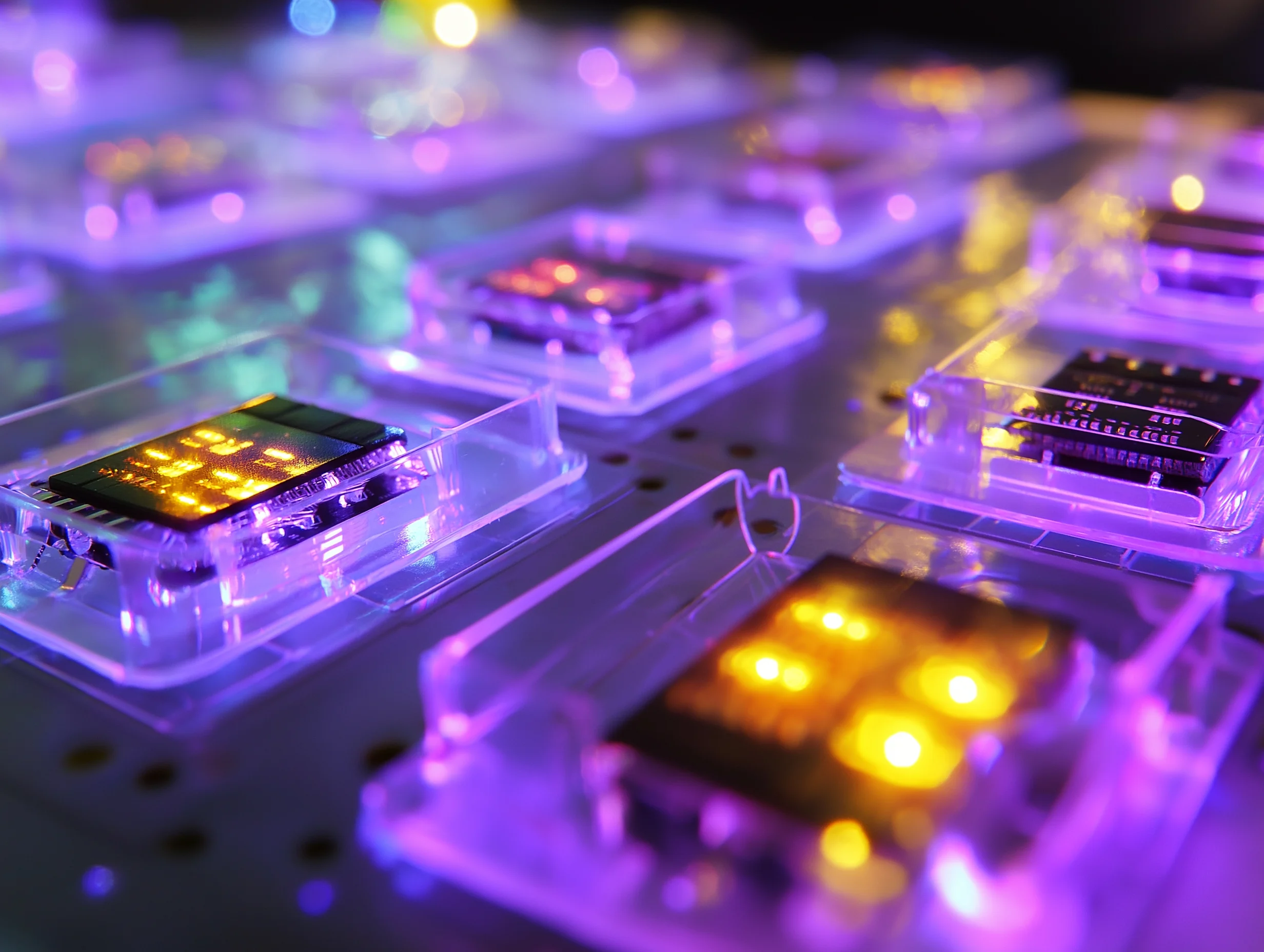
Have you ever wondered how we can make AI smarter, faster, and more efficient? The secret might just lie in a new type of technology: light-powered microchips. These chips don’t work like the regular ones we’re used to, powered by electricity. Instead, they use light to perform tasks. Sounds futuristic, right? Let’s explore how these chips are changing the way we train AI, and why they might be the key to faster, more powerful technology.
What Makes Light-Powered Microchips So Special?
In the world of AI, speed and energy efficiency are everything. Light-powered microchips have some major advantages:
- Speed: Light moves incredibly fast. While traditional chips use electricity (which travels slower), light-powered chips can process information at the speed of light, making calculations faster than ever.
- Energy Efficiency: These chips are much cooler than regular ones. Unlike traditional chips, which generate heat, light-powered chips don’t heat up as much, meaning they’re more energy-efficient and cheaper to run.
- Breaking the Limits of Silicon: Traditional silicon chips have their limits, but light-powered chips aim to go beyond that. By using light, these chips can push the boundaries of what’s possible, helping to train AI models more quickly and without as much power consumption.
Together, these factors make light-powered chips the perfect tool for training advanced AI models more effectively.
How Do Light-Powered Chips Work?
Now that we know what makes these chips special, let’s dive into how they actually work.
These chips use light to perform calculations, which are usually done by regular chips using electricity. They carry out complex mathematical tasks, such as vector-matrix multiplication, at a much faster speed.
Here’s where it gets interesting: Light-powered microchips manipulate the surface of a silicon wafer (the base material of the chip) to control the movement of light. By doing this, they can perform calculations at lightning speed. It’s like the difference between running and flying – both get you where you need to go, but flying is much faster!
Seamlessly Integrating with Existing Tech
The great news is that light-powered microchips don’t require major changes to existing technology. They can easily integrate with current systems, like Graphics Processing Units (GPUs), which are commonly used to train AI models.
For example, these chips can be used to improve the performance of advanced AI models like Google’s Gemini. No need for expensive and time-consuming upgrades to your existing hardware – light-powered chips can be added without much hassle.
Why Should You Care About Light-Powered Microchips?
You might be wondering, “How does this affect me?” Well, here are some ways light-powered microchips could be a game-changer for your work and life:
- Self-Driving Cars: Light-powered chips can speed up the training of AI models used in Lidar systems, which are essential for self-driving cars. Faster training means these cars could become more reliable and safer, sooner.
- Scientific Research: AI is already used to analyse vast amounts of data. With light-powered chips, scientists can speed up this process, making breakthroughs in areas like medicine and climate change much faster.
- Telecommunication Networks: As the world becomes more connected, data speeds are crucial. Light-powered chips could help speed up networks, making communication quicker and more efficient.
Essentially, any AI-powered technology that needs to process large amounts of data quickly could benefit from light-powered chips.
The History Behind Light-Powered Chips
Let’s take a quick look at how this technology came to life. It didn’t happen overnight. Over the past decade, scientists and engineers have been working hard to create a chip that can run complex deep learning algorithms using light.
The result? A photonic processor that can run deep neural networks on a single chip. This breakthrough has made it possible to carry out machine-learning tasks more accurately and faster than ever before. These chips have proven their worth in tests, delivering impressive accuracy and performance.
What’s Next for AI?
You’re probably asking yourself, “What does this mean for the future of AI?” Well, light-powered microchips could be the key to making AI faster and more energy-efficient. In the future, we could see AI that learns at lightning speeds without using up so much energy. This would pave the way for even more advancements in technology.
Join the AI Revolution with Light-Powered Chips
The beauty of light-powered chips is that they’re not just for big companies. Small businesses and startups can also use these chips to accelerate their AI models. If you’re working on a project that involves AI, integrating light-powered chips could give you a significant edge.
For example, AI tools like EzMessengerAI and Opus Pro are great for small businesses looking to implement AI solutions. Light-powered microchips can help your AI system run faster and more efficiently, which is crucial for staying competitive in today’s market.
Frequently Asked Questions (FAQs)
You may still have some questions about these revolutionary chips. Let’s clear them up:
- Do light-powered chips overheat? No. Because they use light, these chips generate much less heat compared to traditional chips, making them more energy-efficient.
- Are light-powered chips expensive? Initially, yes. As with most new technology, they can be more costly upfront. However, as production scales, prices are expected to drop.
- Can I use light-powered chips in my AI projects? Absolutely! These chips are designed to integrate seamlessly with existing GPU systems, so they can easily be added to your tech stack.
Wrapping It Up
Light-powered microchips are set to revolutionise the way we train AI. They are faster, more energy-efficient, and break the limits of traditional silicon chips. Thanks to years of research, these chips are now ready to take AI to new heights. Whether you’re working on self-driving cars, scientific research, or telecommunications, these chips are set to improve your AI training and save you time and money.
If you’re interested in how AI is changing industries, check out our blog on AI in Manufacturing and stay ahead of the curve. The future of AI is bright, and light-powered microchips are lighting the way.